Carpet Area vs Built-up vs Super Built-up — What Indian Buyers Need to Know in 2026
When a builder advertises a '1,200 sqft 2 BHK,' what does that actually mean? In India, the same flat can be marketed as three different sizes. Here's how each is measured and which number actually decides what you're paying for.

99LAND
99Land Editorial
You're shortlisting two apartments. One is advertised as "1,200 sqft 2 BHK for ₹85 lakh." The other is "950 sqft 2 BHK for ₹85 lakh." Same layout, same city, same builder grade. Which one is the better deal?
If you said the first, you've just made the mistake almost every first-time buyer in India makes. The two flats may actually be the same size. The builders simply chose to advertise different "areas."
This is the single biggest source of confusion in Indian apartment buying, and it costs buyers lakhs every year. Here's how the three "areas" actually work, which one decides what you really get, and how to compare flats fairly.
The three areas, defined
Carpet area is the area of the apartment that you can actually carpet — the floor space inside the walls of each room. It excludes the thickness of the walls, but includes everything inside: bedrooms, living room, kitchen, bathrooms, balcony (counted separately in many states).
This is the usable area. If a flat has 800 sqft of carpet area, that's exactly the amount of floor you can walk on.
Built-up area is the carpet area plus the thickness of the inner and outer walls of the apartment, plus any private terraces or balconies attached to it. As a rule of thumb, built-up area is typically 15–20% larger than carpet area for the same apartment.
For an 800 sqft carpet area flat, you'd expect built-up area to be around 920–960 sqft.
Super built-up area is the built-up area plus the flat's "share" of the building's common areas — lobbies, lift wells, staircases, corridors, club house, security cabin, generator room, parking driveways, the manager's office, the gym, the swimming pool surround, even the boundary walls. The builder divides the total common area by the total number of flats (or by total built-up area) and assigns each flat a share.
For an 800 sqft carpet apartment, you might see super built-up of 1,100 to 1,300 sqft. That's an inflation of 35–60% over the actual flat size.
What is the "loading factor"?
The percentage by which super built-up exceeds carpet area is called the loading factor (or sometimes "super area loading"). It's the builder's way of expressing how much common area is being attributed to your flat.
- Loading factor of 20% means a 1,000 sqft super built-up flat has 833 sqft of carpet area
- Loading factor of 35% means the same 1,000 sqft super built-up has only 740 sqft of carpet
- Loading factor of 50% (which existed before RERA) meant you got 667 sqft for a "1,000 sqft" flat
Loading factors above 30% are aggressive. Above 35% is exploitative. Yet many projects, especially in metros, historically charged buyers on super built-up areas with 30–40% loading.
Why RERA changed everything
The Real Estate (Regulation and Development) Act, 2016, brought a hard rule that fundamentally rewrote how apartments are sold in India:
> Builders can only advertise prices on the basis of carpet area.
This isn't a guideline. It's law. Every RERA-registered project must publicly disclose:
- The exact carpet area of every flat
- The exact common-area definition
- The "balcony area" separately (it's not added to carpet)
If a brochure for a RERA-registered project quotes price-per-sqft on super built-up area, the builder is technically violating RERA disclosure rules. The price you see should be in ₹ per sqft of carpet.
In practice, builders still verbally discuss super built-up numbers. ("This flat is 1,200 sqft super, 900 sqft carpet.") But the sale agreement, the booking form, and the registered sale deed all use carpet area — and so do RERA's complaint adjudications.
What this means when you're comparing flats
When two builders give you "1,200 sqft" and "950 sqft" flats, ask one question first:
> "Is that carpet area, built-up, or super built-up?"
You will be amazed how many sales agents struggle to answer this clearly. That alone is a red flag. A good agent will give you all three numbers without hesitation.
To compare fairly:
- Force every flat onto the same basis — usually carpet area.
- Calculate the effective ₹/sqft of carpet by dividing the total price (excluding GST, registration etc.) by the carpet area.
- Compare carpet ₹/sqft, not advertised ₹/sqft.
A "1,200 sqft" flat at ₹85 lakh might actually be 750 sqft carpet → ₹11,333/sqft of usable space. A "950 sqft" flat at ₹85 lakh might be 880 sqft carpet → ₹9,659/sqft of usable space.
The second flat is 17% cheaper per usable sqft even though the headline number looks smaller. This is exactly how builders confuse buyers.
What about balconies and utility areas?
RERA treats balconies as separate from carpet area, but most flats include them in the carpet number you see. You'll often see:
- Carpet area: 800 sqft (interior usable floor)
- Balcony area: 90 sqft
- Utility / service area: 40 sqft
- Total saleable: 930 sqft (in some quotes)
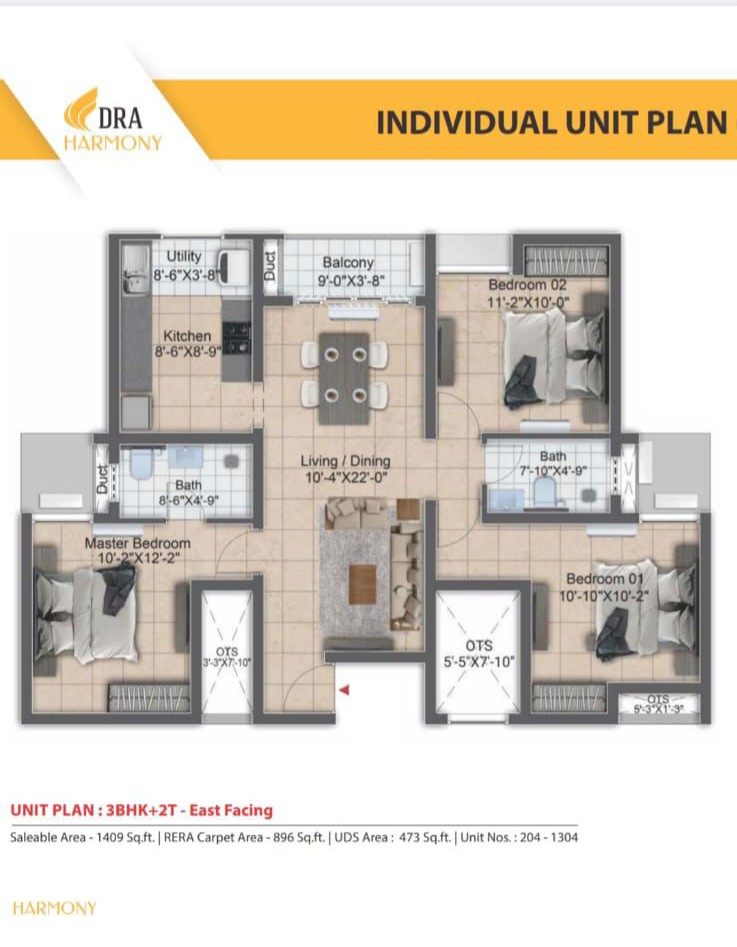
Builders include or exclude these inconsistently. Always insist on a floor plan with each area labelled separately. If the plan doesn't show this, ask for one — every RERA-registered builder is required to provide it.
Loading factor benchmarks by city
These are rough 2025 norms — verify with the actual brochure:
- Mumbai: 30–40% (highest in India due to vertical density and lift-heavy buildings)
- Bengaluru / Hyderabad / Pune: 22–32% (modern integrated townships push this higher)
- Chennai / Coimbatore: 18–28%
- Tier-2 cities (Trichy, Madurai, Jaipur, Lucknow): 15–22%
If a builder in Chennai is quoting 35%+ loading, ask hard questions about what common areas justify it.
Practical buyer's checklist
- <span style="display:inline-block;width:1.1em">☐</span> Ask carpet, built-up, and super built-up for every flat you visit
- <span style="display:inline-block;width:1.1em">☐</span> Confirm the RERA registration ID and pull the carpet area from the RERA portal yourself
- <span style="display:inline-block;width:1.1em">☐</span> Calculate ₹/sqft of carpet before comparing prices
- <span style="display:inline-block;width:1.1em">☐</span> Check the loading factor; flag anything over 30%
- <span style="display:inline-block;width:1.1em">☐</span> Insist on a labelled floor plan
- <span style="display:inline-block;width:1.1em">☐</span> Confirm in writing that the sale deed uses carpet area (it should, by law)
- <span style="display:inline-block;width:1.1em">☐</span> Visit the flat and pace it out — does it feel like the carpet number the builder gave you? A 750 sqft carpet 2BHK is small; a 1,000 sqft carpet 2BHK is roomy. If the flat feels smaller than the number, the number is wrong.
What about resale apartments?
For pre-RERA buildings (most resale apartments built before 2017) you'll often see only super built-up in the original sale deed. To find the real carpet area:
- Get the building plan from the seller
- Or just measure the flat yourself — every dimension, every wall, every room
- 30 minutes of measuring + a calculator gives you the carpet area more reliably than any document
The TL;DR
Carpet area is what you actually live in. Built-up adds walls. Super built-up adds your share of corridors, lifts and clubhouse. Builders price on whichever number flatters them most. RERA forces them to disclose carpet, but only buyers who know to ask will get a clear answer.
If you're shortlisting apartments and want to filter by genuine carpet sizes up front, browse apartments in Chennai, Bengaluru, Hyderabad, or Mumbai on 99Land — our listings show carpet area on every flat where the seller has disclosed it.
One question, every flat, every time: "How much carpet area?" That's it. Don't pay for square feet you can't stand on.
Safety checklist for everyone in this deal
A property transaction in India touches a lot of hands. Here's what each party should insist on before money moves.
Buyers
- Verify title through a 30-year EC (Encumbrance Certificate) and cross-check the mother deed.
- Confirm RERA registration (where applicable) — the RERA number should match the one on the state RERA website.
- Never transfer a token amount on WhatsApp alone; insist on a receipt and a simple written agreement.
- Walk the property in person. Photo-only deals are a common vector for listing fraud.
Sellers
- Keep originals in a locker. Only ever share certified copies with prospective buyers.
- Insist on payment via cheque / NEFT / RTGS — avoid cash-heavy deals, especially above ₹2 lakh (20,000 cash cap for each leg under Section 269ST).
- Never hand over vacant possession until the sale deed is registered and the registration receipt is in your hand.
Agents, agencies and brokers
- Register under the state RERA (where brokering RERA-covered projects) and display your registration number on listings.
- Keep a written, dated engagement letter with the client covering brokerage %, exclusivity and a cancellation clause.
- Do a KYC on both sides before the first site visit — PAN + Aadhaar, photo ID match — and hold a copy on file.
- Never pocket earnest money directly; let it flow buyer ↔ seller and invoice the brokerage separately.
Owners
- Update your property tax every year — BBMP / MCD / BMC arrears follow the property and surface at sale time.
- On rental, include a 2–3-month notice period, a detailed inventory with photos, and a clause on painting + deep-cleaning at exit.
- Pay the rental TDS if you're a tenant paying over ₹50,000/month (Section 194-IB). Owners should chase the Form 16C from their tenant.
Final tip: when in doubt, walk away. The best real-estate deals are the ones you don't rush.
Platinum Listings
Top-tier promoted properties

Premium Listings
High-visibility promoted properties
Featured Properties
Handpicked properties just for you