DTCP vs CMDA Plot Approval — Which is Safer to Buy in Tamil Nadu? (2026)
Every layout in Tamil Nadu is sold as 'DTCP approved' or 'CMDA approved' — but most buyers don't know what either means. This guide explains the real difference, the legal weight, and how to verify approval before paying.

99LAND
99Land Editorial

Walk into any plot office in Tamil Nadu and you'll hear the same two words within 30 seconds: "DTCP approved" or "CMDA approved." Sellers throw them around like proof of safety. Most buyers nod along without knowing what either authority actually does, what an "approval" actually guarantees, and — critically — whether the approval being claimed even exists.
This guide cuts through the marketing. By the end you'll know which approval applies where, what an approved layout actually promises you (and what it does not), and how to verify the claim before signing anything.
The 30-second version
- CMDA (Chennai Metropolitan Development Authority) approves layouts inside the Chennai Metropolitan Area — roughly 1,189 sq km covering Chennai city + parts of Tiruvallur, Kanchipuram, and Chengalpattu.
- DTCP (Directorate of Town and Country Planning) approves layouts in the rest of Tamil Nadu — Coimbatore, Madurai, Trichy, Salem, Erode, Tirunelveli, and every other district.
- They're not "competing" approvals. They're geographic. The same layout cannot be both DTCP and CMDA approved.
If a seller in Coimbatore tells you their plot is "CMDA approved," they're either confused or lying. CMDA has no jurisdiction in Coimbatore.
What does "approval" actually mean?
Both DTCP and CMDA do roughly the same thing — they regulate layout development. When a developer wants to convert a piece of agricultural land into a residential layout with internal roads, parks, drainage, and individual plots, they must submit the layout plan to the relevant authority for approval.
An approved layout means:
- Internal roads meet minimum width norms (typically 9m, 12m, or 18m depending on plot count)
- Open space reservation (OSR) — at least 10% of the layout is reserved for parks and community use
- Drainage and electrical layouts have been planned
- The conversion from agricultural to residential has been (or will be) processed
- The land is not on prohibited zones — temple poramboke, water body buffers, defence land, etc.
When you buy an approved plot, you can:
- Register the sale deed without complications
- Get building approval to construct a house
- Get a home loan from a bank (banks check this approval status before disbursing)
- Resell the plot easily because the next buyer doesn't have to worry about layout legality
An unapproved layout is the opposite of all of that. You may register the plot, but you cannot get building approval. You may build informally, but the structure has no legal sanction. Banks refuse loans. Resale value crashes.
DTCP — Directorate of Town and Country Planning
DTCP is the Tamil Nadu government department responsible for planned development outside the Chennai Metropolitan Area. Its approval covers most of the state's plot market — Coimbatore, Madurai, Trichy, Salem, Tirunelveli, Erode, Hosur, Vellore, etc.
A DTCP-approved layout will have:
- A unique DTCP approval number (looks like a long alphanumeric reference)
- An approved layout plan stamped by the authority
- An assignment letter for the developer
You can verify any DTCP approval at the Tamil Nadu town planning portal. As of 2026 the portal is integrated with the broader e-Services platform. The exact URL has changed over the years — search "DTCP layout approval verification Tamil Nadu" and use only the .gov.in result.
Things to look for when verifying:
- The approval number the seller gave you actually exists in the portal
- The survey number matches the seller's records
- The layout name matches what's on the brochure
- Approval is current — DTCP approvals have validity periods and can lapse
CMDA — Chennai Metropolitan Development Authority
CMDA covers the Chennai Metropolitan Area. The jurisdiction includes:
- The whole of Chennai district
- Large parts of Tiruvallur (Ambattur, Avadi, Tiruvallur town)
- Large parts of Kanchipuram (Sriperumbudur, Tambaram, Pallavaram, Chrompet)
- Large parts of Chengalpattu (OMR up to Mahabalipuram, Vandalur, Guduvanchery)
If you're buying in any of these areas, your plot must be CMDA approved, not DTCP approved. (The same authority also approves building plans for individual plots in this region.)
Verifying CMDA approval:
- The CMDA website lists approved layouts and you can search by layout name, survey number, or approval number.
- An "in-process" or "for sale before approval" status is a red flag — many developers pre-sell plots before approval comes through. You may end up holding land in a layout that never gets approved.
So which is "safer"?
This is a wrong question, but it's the one buyers always ask. The honest answer is: the right one for your location is safer. A CMDA-approved plot in OMR is good; a CMDA-approved plot does not exist in Coimbatore. A DTCP-approved plot in Coimbatore is good; a DTCP-approved plot in Tambaram is a problem because Tambaram falls under CMDA's jurisdiction.
Some developers manage to get both DTCP and CMDA approval for border layouts, but this is rare and you should treat such claims with suspicion until you see both approval orders.
What approval does NOT guarantee
This is where most buyers get a bad surprise. An approval — DTCP or CMDA — does not mean:
- The title is clean. You still need to pull the EC, verify patta, and have a lawyer check the sale deed chain.
- Conversion from agricultural to residential is final. Some layouts get layout approval before final conversion is issued. Insist on the conversion order copy.
- The developer owns all the land in the layout. Some layouts include "joint development" parcels where another party has a claim.
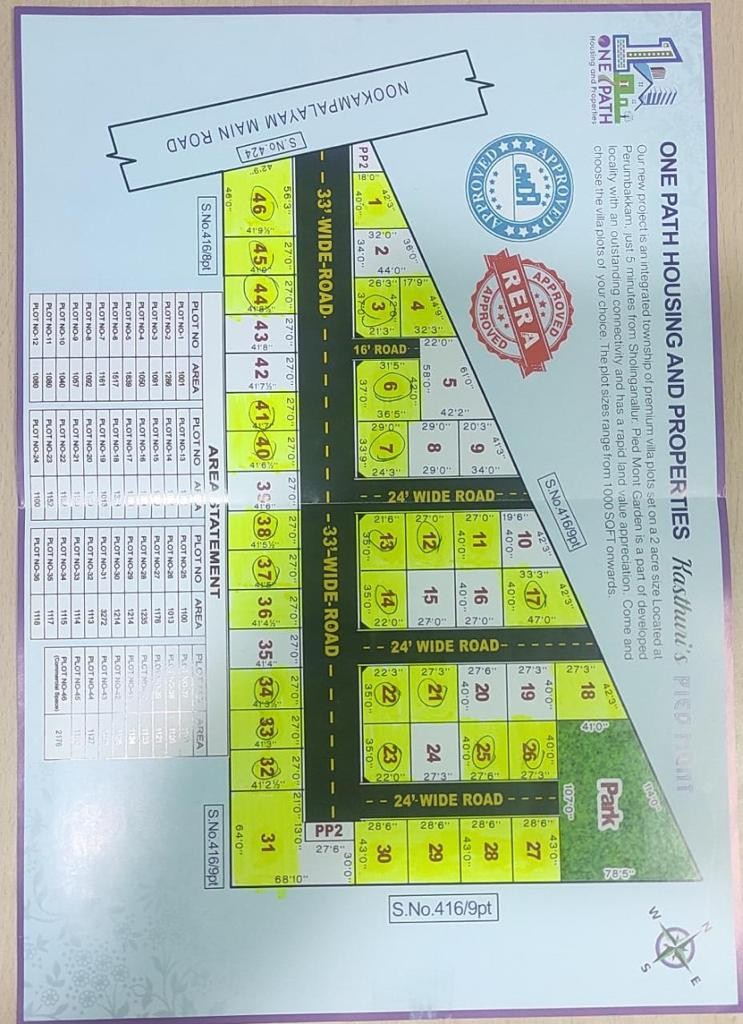
- The plot you're being shown is the actual plot in the approved layout. Some sellers will show you Plot 12 on a brochure but the registered survey number is Plot 47, which is on the corner with road-widening cuts. Match the approved layout plan against the FMB sketch on site.
In short: approval is necessary but not sufficient. It's one of about eight checks every plot buyer should do.
Red flags when sellers talk about approval
- "DTCP approval is in process, we'll get it after sale" → Walk away. You can't fix this after paying.
- "Approval letter was given but we don't have a copy right now" → No copy means no approval until proven otherwise.
- "CMDA approved layout" sold outside CMDA jurisdiction → They don't know what they're selling.
- "Pre-launch price for unapproved plots" → This is a recurring scam pattern in Tier-2 TN. Plots sold below market on the promise of future approval. Approval often never comes.
- "This is a panchayat-approved layout" → Panchayat approval does not equal DTCP/CMDA approval. Panchayat-only approvals are weak; banks won't finance.
The buyer's quick check
Before paying any advance on a Tamil Nadu plot:
- <span style="display:inline-block;width:1.1em">☐</span> Confirm which authority should have approved this layout based on its geographic location
- <span style="display:inline-block;width:1.1em">☐</span> Get the approval number and look it up on the official portal yourself
- <span style="display:inline-block;width:1.1em">☐</span> Match approval order's survey number with the patta you've verified separately
- <span style="display:inline-block;width:1.1em">☐</span> Verify the approval is current (not lapsed)
- <span style="display:inline-block;width:1.1em">☐</span> Cross-check approved layout plan against the physical layout on site
- <span style="display:inline-block;width:1.1em">☐</span> Confirm the developer's name on the approval matches the seller's sale deed chain
This is genuinely 30 minutes of work. It is by far the highest-ROI 30 minutes you'll spend in the buying process.
Closing
DTCP vs CMDA isn't a quality contest — it's a geography test. Both are legitimate state authorities. What kills buyers is not which one approved their plot but whether the approval actually exists and applies to the parcel they're buying.
If you're starting your search, you can filter by approval type on most listings — browse plots in Chennai (CMDA territory) and plots in Coimbatore, Madurai, or Trichy (DTCP territory) on 99Land to start with sellers who have provided approval documents up front.
Two layouts, two authorities, one rule: verify the approval yourself before believing the brochure.
Safety checklist for everyone in this deal
A property transaction in India touches a lot of hands. Here's what each party should insist on before money moves.
Buyers
- Verify title through a 30-year EC (Encumbrance Certificate) and cross-check the mother deed.
- Confirm RERA registration (where applicable) — the RERA number should match the one on the state RERA website.
- Never transfer a token amount on WhatsApp alone; insist on a receipt and a simple written agreement.
- Walk the property in person. Photo-only deals are a common vector for listing fraud.
Sellers
- Keep originals in a locker. Only ever share certified copies with prospective buyers.
- Insist on payment via cheque / NEFT / RTGS — avoid cash-heavy deals, especially above ₹2 lakh (20,000 cash cap for each leg under Section 269ST).
- Never hand over vacant possession until the sale deed is registered and the registration receipt is in your hand.
Agents, agencies and brokers
- Register under the state RERA (where brokering RERA-covered projects) and display your registration number on listings.
- Keep a written, dated engagement letter with the client covering brokerage %, exclusivity and a cancellation clause.
- Do a KYC on both sides before the first site visit — PAN + Aadhaar, photo ID match — and hold a copy on file.
- Never pocket earnest money directly; let it flow buyer ↔ seller and invoice the brokerage separately.
Owners
- Update your property tax every year — BBMP / MCD / BMC arrears follow the property and surface at sale time.
- On rental, include a 2–3-month notice period, a detailed inventory with photos, and a clause on painting + deep-cleaning at exit.
- Pay the rental TDS if you're a tenant paying over ₹50,000/month (Section 194-IB). Owners should chase the Form 16C from their tenant.
Final tip: when in doubt, walk away. The best real-estate deals are the ones you don't rush.
Platinum Listings
Top-tier promoted properties

Premium Listings
High-visibility promoted properties
Featured Properties
Handpicked properties just for you